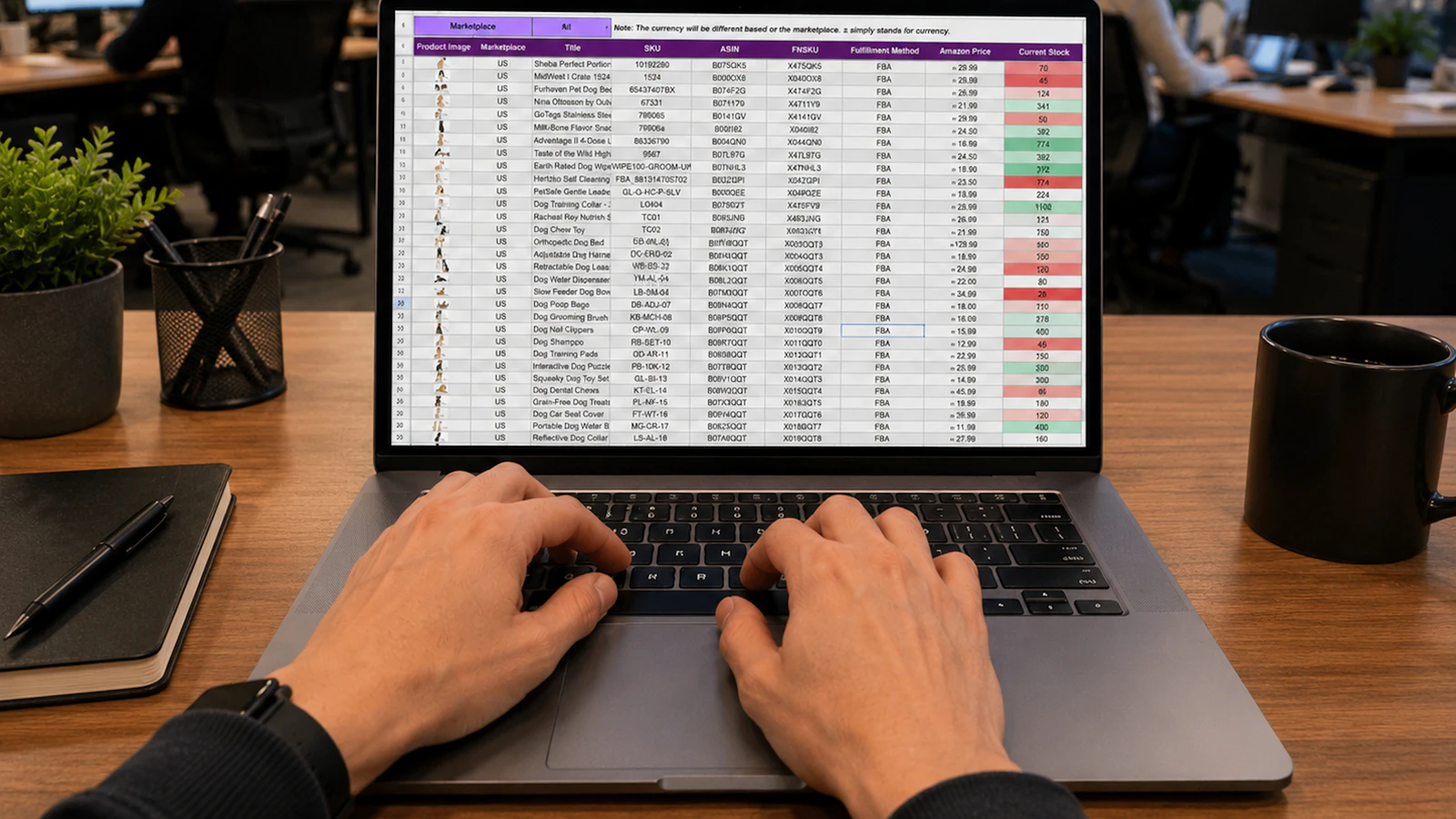
Once a month, a supplier sends a PDF catalogue of deals. Everything downstream hangs off that one file: the B2B website, the online store, and a month of social content for two very different brands.
Done by hand, that means updating the site, checking more than 30 listings, and building posts for two audiences who should never sound alike. For one person, that does not scale. So I turned it into a process.
This post is not about the process, though. It is about the moment a tool told me everything was fine and was off by a third.
What is my take on automating business tasks?
My view: automate the boring parts and keep a person on the sign-off. An automation that runs unchecked is not saving you time, it is borrowing it, and the bill arrives as a wrong price on a live page. I would rather have a slower process I trust than a fast one I have to apologise for. That is an opinion, of course. The counting habit below is the part I would defend to anyone.
What happened with the 20 out of 30?
At one step a Shopify tool was asked to check the products. It reported success. It had returned 20 of the 30 products, with no warning, no error and no note saying "I stopped early". A third of the catalogue would have gone unchecked if I had not counted.
I only noticed because I count. I count the input, I count the output, and I compare. It is the least clever habit I have and it has saved me more than anything clever.
There are many reasons a tool might return fewer results than exist. A common one in online stores is that results come back in pages and only the first page is returned. Shopify documents how this works in paginating results with GraphQL. I will not claim that was the cause here, because I did not need to know: the fix is the same either way. Do not trust a number you did not check.
Why is "it said it worked" not good enough?
Because the failure mode of automation is silence. A person who skips something usually mentions it. A tool that skips something usually reports success.
So every step in my process now has a count attached:
- How many items went in?
- How many came out?
- If those numbers differ, stop and say why.
It is dull. It is also the difference between a process that runs itself and one that quietly drifts.
How does the monthly process work?
In plain terms, it runs as six steps, ending with one go-live day:
- The catalogue arrives.
- The B2B website update is prepared for review, and the store is audited.
- I mark up every product.
- Drafts and a go-live queue are prepared.
- One go-live day.
- Social content is built for both brands from what is actually live.
There are eight workflows in total behind it. One monthly PDF now updates two websites and four platforms, and a controlled process replaces four separate manual jobs. Product details stay consistent across both sites and every post, and the two brand voices stay separate.
What about prices drawn as pictures?
Here is a wrinkle. The catalogue's prices are drawn as artwork, so software cannot simply read them as text. I read each page as an image instead and flag any price I am not sure of for a manual check. Ambiguous means a human looks. I would rather ask than guess a price that goes on a live page.
Prices matter doubly because Google reads them too. Product information is not decoration. Google explains what it reads in its product structured data guide and the Merchant Center product data specification. A wrong price in a listing is not only embarrassing, it can be disapproved.
Where does AI come in, and who is in charge?
I use AI tools, mainly Claude, for the repetitive parts. I designed the process, I wrote every rule, and I sign off every change. Nothing reaches a customer without my approval. That last sentence is the one I would want to see in anyone's process, whether they use AI or interns.
The 20-of-30 incident is the best argument for that. A tool did exactly what it was built to do and still got it wrong. A person checking the count is cheap insurance.
What can I borrow for my own business?
You do not need my tools. You need the habits:
- Pick one recurring job that eats your time, such as a monthly price update or report.
- Write it as numbered steps and say who does each.
- Attach a count to every step. Items in, items out.
- Put one human approval before anything customer-facing.
- Look at the log after the first few runs, not just the result.
Once that works by hand, then automate the boring bits. Not before. For the full story, see Case 006 in the case files, or book a call if a monthly chore is eating your week.
Frequently asked questions
Should I automate a process before I understand it?
No. Run it by hand a few times first. Automation locks in whatever you taught it, mistakes included.
How do I know an automation is silently failing?
Count inputs and outputs, and read the log. A good automation reports what it did, not just whether it finished.
Can AI tools be trusted to do this kind of checking?
They are very useful, and they can be confidently wrong. Use them for the repetitive work and keep a person in charge of the rules and the sign-off.
What is the simplest first automation for a small business?
Anything that repeats on a schedule and has a clear answer: a monthly report, a price update, an invoice reminder.