Who I help
The owner doing everything
- I'm the owner, the marketer, the IT guy and occasionally the cleaner.
- Our website was built in 2019 by someone's nephew. We're scared to touch it.
- People say they can't find us on Google. I can't find us on Google.
I get you found, then get you enquiries.
- A website that works properly on phones
- SEO so Google actually shows you
- A verified Google Business Profile
- Tracking, so you know where customers come from
An online store Google couldn't see went from 0 to 4-5 quote requests a week. All organic.
The team losing leads
- Leads vanish into WhatsApp, inboxes and Sipho's memory.
- Nobody knows what's in our pipeline right now.
- Two of us called the same customer last week. Awkward.
I build systems that catch every lead and hand it to the right person.
- A CRM your team will actually use, even on their phones
- Website forms that create deals automatically
- Alerts for new leads and follow-ups
- One clear view of every deal
I built a sales CRM from scratch. Every website enquiry lands as a tagged deal. Try the demo further down.
The one an agency burned
- We paid every month for a report nobody understood.
- Our Google account is under the agency's login. They've stopped replying.
- Something broke after their last 'update' and nobody noticed.
I take back control, and I tell you the truth.
- Audit every account and move ownership back to you
- Untangle the apps fighting each other
- Measure what actually matters to your business
- A plain-language, prioritised to-do list
I reclaimed agency-owned Google, Meta and TikTok accounts and cut four clashing SEO apps down to one.
The store that looks fine but isn't
- Traffic looks okay. Sales don't.
- Search Console keeps emailing me errors I don't understand.
- We rename a product and half our links die.
I find the leaks and plug them.
- Technical SEO and product data Google can read
- Product pages written to sell
- Redirects that look after themselves
- Tracking built around the action that makes you money
189 broken links fixed with 121 redirects, plus a watcher that now catches new ones on its own.
The team that needs a unicorn
- We need someone who gets marketing AND can talk to developers.
- Our last hire was great at posting. Less great at anything technical.
- We can't afford five specialists yet.
I'm the one person who connects the dots.
- Strategy, content and design
- Websites, data and systems
- Fixing the process, not just the problem
I currently run marketing and IT for two brands and 20+ stores, on my own.
Problems I fix
- We don't show up when people Google what we do: SEO + Google Business Profile
- Leads get lost between the website, WhatsApp and email: CRM + automatic lead capture
- We don't know where our customers come from: GA4 + proper conversion tracking
- Our website looks dated or breaks on phones: A website rebuild that converts
- An agency or ex-staffer still owns our accounts: Account audit + ownership handover
- We pay for tools nobody uses: Tool clean-up (your budget will thank you)
- Our social media is... sporadic: A content system that runs monthly
The roles I cover
- Web developer. Took a B2B brand from an empty domain to a live website with 63 products and 3 lead tools.
- CRM builder. Designed and shipped a sales CRM across 8 build phases, linked to the website.
- SEO specialist. Found the one setting that stopped Google indexing 39 pages.
- Content writer. 33 articles written or rewritten across two brands' blogs.
- Social media manager. Started and runs LinkedIn, Instagram, Facebook and TikTok for two brands.
- Graphic designer. 94 site images, 17 banners, carousels, staff campaigns and store flyers.
- Brand builder. Finalised a 7-variation logo system and four brand documents for a B2B brand.
- Paid media planner. Pitched a 2-month ad plan that stretches R24,000 into roughly R30,000 of delivery.
- IT support. DNS, email security, hardware and connectivity for head office and 20+ stores.
- Systems designer. Turned one monthly supplier PDF into updates across 2 websites and 4 platforms.
The case files
Case 001: The B2B brand with no front door (Live)
The situation. A telecoms retail group had just launched a B2B brand. It had no real website, no way to capture leads and no consistent look. Business customers had nowhere to land.
What everyone assumed. "It's just DNS propagation. Give it a day."
What was actually going on. After the DNS changes the site wouldn't load. The real cause was the browser holding on to old security settings for the domain, an HSTS cache. Waiting would never have fixed it.
What I did.
I planned and built the site from scratch: eight solution pages, a 63-product catalogue with a quote drawer, 21 articles rewritten into the brand's voice, and three free tools that bring in leads (a connectivity health check, a bill audit and a downtime cost calculator).
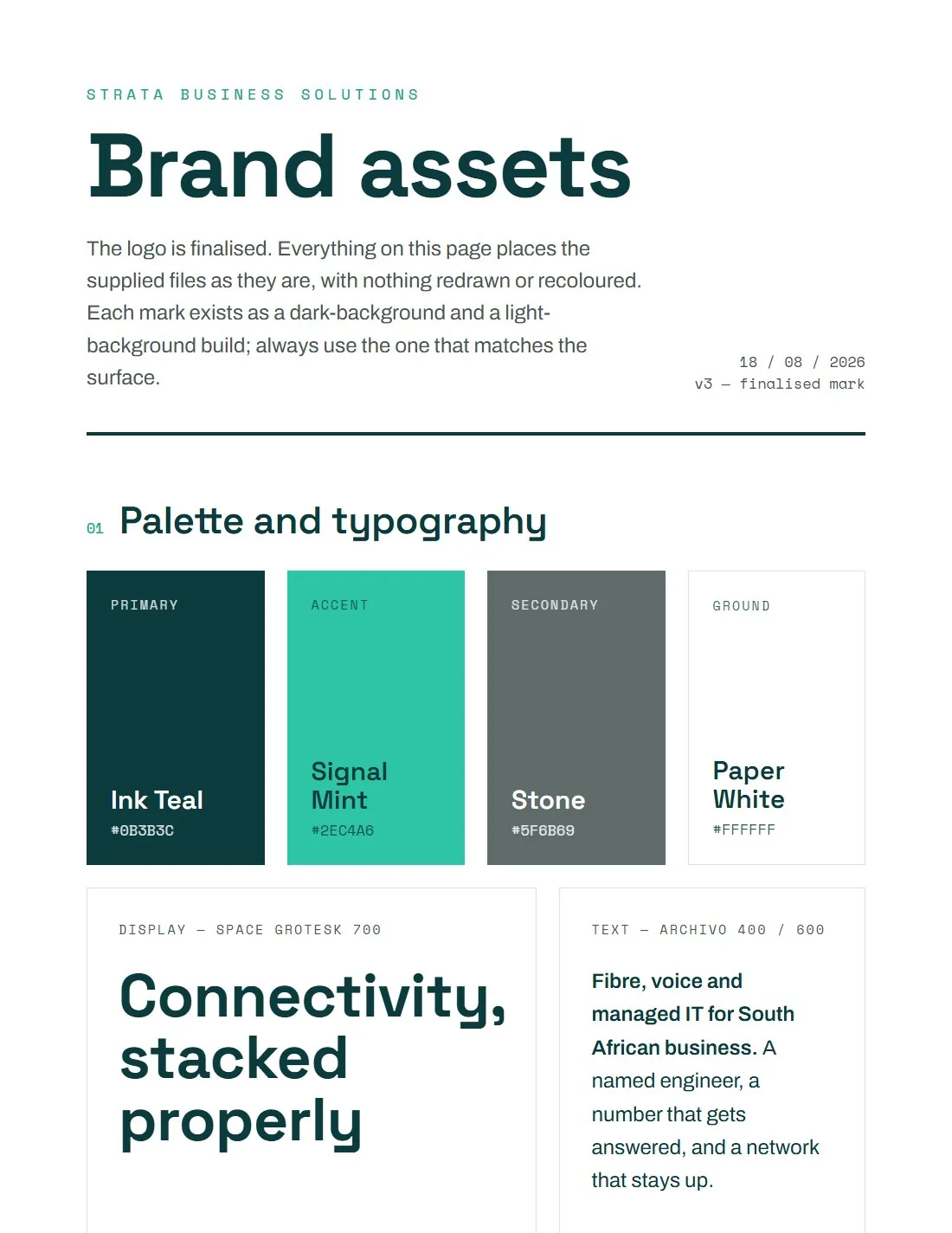
On the brand side, I finalised the logo system with seven variations, rewrote four brand documents around it, and built an email signature generator any new hire can use in two minutes.
The result. A live B2B site that feeds leads straight into the sales team's CRM (see Case 002).
Case 002: Leads that lived in inboxes (In test rollout)
The situation. The sales team tracked deals in their inboxes and their heads. Nobody could see the pipeline, and nothing connected marketing to sales.
What everyone assumed. "No error message means it worked."
What was actually going on. Notification emails were silently never sending. The serverless function was shutting down before the email code got a chance to run. I kept it alive until the email completed. A second bug made reassigned leads half-invisible, so checking for it became a standing rule for every new page.
What I did.
I gathered requirements from sales, finance and the repair centre, then built a click-through prototype first so the team could react to every screen before any real code existed. That's how we found out the sales admin works her own deals as well as overseeing the team, so she got a "Team / My pipeline" toggle.
Invite-only logins, three roles, a kanban pipeline, customer profiles, notifications and branded emails. Permissions are enforced in the database, so a consultant only ever sees their own leads, even if they type a URL directly.
The result. A working CRM in phased testing with a small group before the whole team moves over. Try the demo on this page, with fictional data.
Case 003: The pages Google couldn't see (Solved)
The situation. The new B2B website scored A+ for content and was close to invisible anyway. 39 pages weren't indexed, analytics recorded nothing and the site had zero backlinks.
What everyone assumed. "Google is slow. Give it time."
What was actually going on. One setting was giving Google three different answers. The sitemap said one address, the server redirected to another, and that page pointed back to the first. Google went round in circles. Analytics was blank because the tracking ID had been saved as the wrong type of variable.
What I did.
I checked every audit finding against the live site first, which ruled out two false alarms before anyone touched code. Then I fixed the address setting, fixed the tracking variable, removed a file slowing the mobile load and added the missing image descriptions.
I also chose to leave one thing alone: a CDN rebuild to remove a single redirect hop would have cost far more than it gained.
The result. Sitemap and canonical tags now agree, confirmed live. Analytics is recording. Domain Rating went from 0 to 3, and link building is next.
Case 004: 189 dead ends (Self-maintaining)
The situation. Google Search Console flagged 189 of the online store's URLs going nowhere, building up since March.
What everyone assumed. "A few broken links. No big deal."
What was actually going on. Two causes. A bulk rename of collection links broke every old bookmark and search result, and expired monthly deals were being deleted, each one leaving a dead page behind.
What I did.
I created 121 redirects with zero errors, sending discontinued deals to the closest matching collection rather than a dead page.
Then I fixed the habit as well as the backlog: a weekly watcher now compares the store against a saved snapshot and redirects anything renamed or removed.
The result. On 14/09/2026 the watcher caught five newly removed deals and redirected all five with nobody touching it.
Case 005: The store that looked broken on paper (Ongoing)
The situation. I inherited the group's online store from an agency. Accounts sat under their login, four SEO apps were fighting each other, product schema was broken and the store had never recorded a completed online purchase.
What everyone assumed. "No checkouts means the site doesn't work."
What was actually going on. The store sells cellphone contracts. Customers click Add to Quote online and close the deal in-store after credit checks. Measuring checkouts was measuring the wrong thing.
What I did.
I made Add to Quote the conversion that counts on every platform, pulled the Google, Meta and TikTok accounts back under company control, and traced the broken schema to the exact character where it failed.
I cut four SEO apps down to one, published 12 articles across two new blogs, and replaced 17 banners and 4 homepage tiles with 94 images I made myself. When a theme update silently wiped the quote system, I rebuilt it and wrote a checklist so it can't happen quietly again.
The result. Before, the store didn't show up in search and quote requests sat at zero. Now 4 to 5 come in every week. All organic, no ad spend yet.
Case 006: One PDF, every channel (Running monthly)
The situation. Almost everything hangs off one event: the supplier's monthly deals catalogue arrives as a PDF. That meant updating the B2B site by hand, checking 30+ listings, and building a month of social content for two very different brands. For one person, that doesn't scale.
What everyone assumed. "The tool says it checked everything."
What was actually going on. The catalogue prices are drawn as artwork, so code can't read them. I read each page as an image and flag doubtful prices for a manual check. Later, a Shopify tool quietly returned 20 of 30 products with no warning. A third of the catalogue would have gone unchecked if I hadn't counted.
What I did.
- Catalogue arrives
- B2B website update prepared for review + store audit
- I mark up every product
- Drafts and a go-live queue get prepared
- One go-live day
- Social content built for both brands from what's actually live
Eight workflows in total. I use AI tools, mainly Claude, for the repetitive parts. I designed the process, wrote every rule and sign off every change. Nothing reaches a customer without my approval.
The result. One controlled process replaces four manual jobs. Product details stay consistent across both sites and every post, and the two brand voices stay separate.
The cross-examination
You're young. How much experience do you really have?
Enough to be the only marketing and IT person for two brands and 20+ stores, and to ship a B2B website, a CRM, an online store rebuild and a monthly content system on my own. My age tells you when I started. The case files tell you what I've done since.
Do you actually know this, or does AI do it for you?
I know what I'm building and why. AI speeds up the typing, but I'm the one deciding what gets built, checking every result and signing off before anything goes live. I learnt the SEO, the DNS and the database rules by doing them, occasionally breaking them and fixing them again, which is a very effective (if slightly stressful) teacher. Pick any case on this page and I'll happily walk you through what went wrong, what I tried first and why the fix worked.
You work alone. Can you work in a team?
I built the CRM by gathering requirements from sales, finance and the repair centre, and I run every big decision past the director. I have mentors I learn from constantly. Working alone is my current setup. It isn't my preference.
What happens when you don't know something?
I say so, and then I go and find out. An automation couldn't reach our code even though GitHub showed it as connected. Instead of accepting "you need an admin", I dug in and found that authorising an app on GitHub and installing it are two separate steps. Only installing gives it access.
Why aren't your social numbers huge?
Fair question. Everything so far has been organic, with no ad budget yet, and I started most of those pages from zero. What I'd point you to is the online store: it wasn't even showing up in search, and now it brings in 4 to 5 quote requests a week. Picture what that does with a budget behind it.
You say you're quiet. Can you handle clients?
I write clearly. I've written director pitches, user guides and brand documents, and I recorded the video at the top of this page (well, I will). Quiet means I listen before I talk. You'll find that useful.
What are you open to?
Honestly? Most things. A full-time role, a freelance project, a collaboration, a business that needs its marketing and tech sorted out. If there's a real problem to solve and people who care about solving it, I'm interested.